Visiting El Badi Palace
El Badi Palace is the great ruin at the heart of the Marrakech medina: the roofless shell of what was once the most extravagant palace in Morocco, built by a Saadian sultan from gold and Italian marble, then stripped to its walls a century later. It stands in the Kasbah district, in Ksibat Nhass, a minute’s walk from Place des Ferblantiers (Tinsmiths Square), inside the Medina of Marrakesh — a UNESCO World Heritage Site.
Below you’ll find the current 2026 opening hours, what a ticket actually costs at the gate and from us, what there is to see across the site, how to get there, and how to set your expectations — because El Badi is a ruin, and knowing that before you go is the difference between a highlight and a disappointment.
Our team regularly checks every detail on this page to keep it accurate — especially opening hours, which often change during Ramadan and religious holidays.
Bahia Palace opening hours
Last checked: 10 July by OUSSAMA, LOCAL GUIDE, licensed guide in Marrakech since 2010.
The best light is early, before the sun is high over the open courtyard, and again in the last hour before closing when the walls turn gold and the storks settle on the ramparts.
Ramadan and Eid hours are set locally and can shift by a day or two depending on the lunar calendar. If you’re visiting during either.
Is El Badi Palace worth visiting?
Yes — but only if you know what you’re walking into.
El Badi is a ruin, and deliberately so. In the 1690s the sultan Moulay Ismail had it systematically stripped — the marble, the gold, the onyx, the cedar — and carried north to build his new capital at Meknes. What’s left is the skeleton: colossal rammed-earth walls, a vast sunken courtyard, orange trees growing where reception halls once stood, and storks nesting on the ramparts. There are no furnished rooms. There is no roof. Visitors who arrive expecting a restored palace like the Bahia are often taken aback.
So come for what it actually is. The scale is genuinely staggering — this was 360 rooms and a courtyard the length of a football pitch, all built to humble visiting ambassadors. Stand in the middle of the empty esplanade and the emptiness is the point: this is what happens to the most magnificent palace in the empire when the next dynasty decides it wants the marble.
The other reason to go is the view. The rooftop terrace and ramparts — currently open — give you one of the best panoramas in the medina, over the whole Kasbah quarter toward the Atlas Mountains, with the stork nests at eye level.
This is a site where a guide changes everything. Without one, you’re looking at big brown walls. With one, you’re standing inside the story of Saharan gold, a stripped empire, and a sultan called “the Golden.” That’s why most of our guests who visit El Badi book a guided walk.
How long do you need? Forty-five minutes to an hour is plenty for most visitors; longer if you’re a photographer or you take a guide.
How to get to El Badi Palace
From Place des Ferblantiers (Tinsmiths Square)
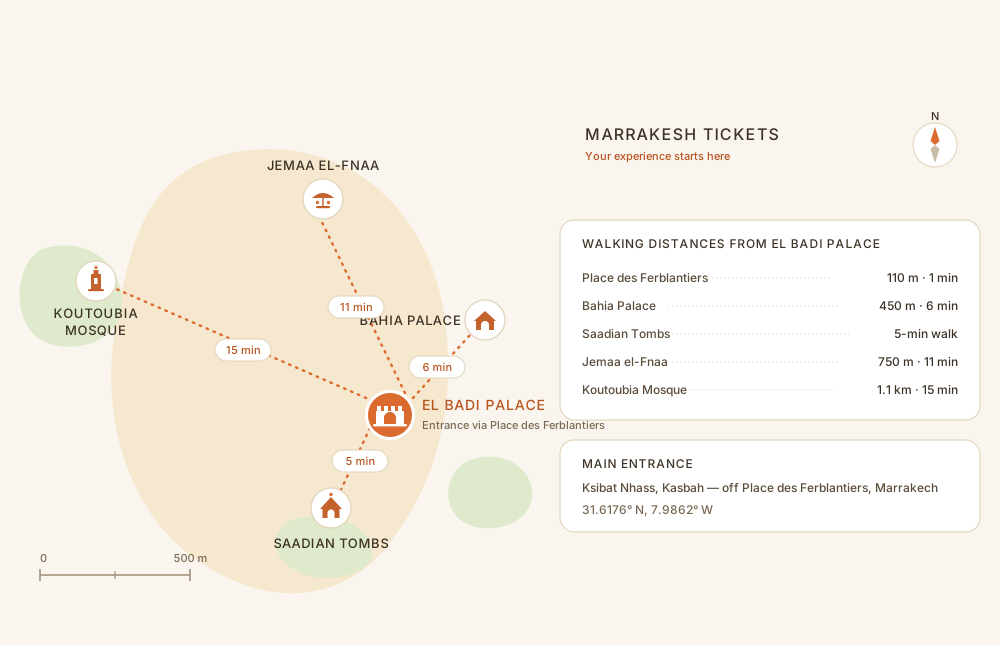
About 1–2 minutes (110 m). From the square, head south through the arch into Ksibat Nhass and the palace entrance is straight ahead. This is the simplest approach and the one to give your taxi or tuk-tuk driver.
On foot from Jemaa el-Fnaa
About 11 minutes (750 m). Leave the square heading south on Rue Riad Zitoun Lakdim and follow it down toward Place des Ferblantiers; the palace entrance is just beyond the square. The route is flat and straightforward.
On foot from Bahia Palace
About 6 minutes (450 m) via Rue Bahia Bab Mellah. The two palaces are close enough to see back-to-back, and together they tell opposite halves of the same story — one intact, one stripped.
By tuk tuk
We collect you from your riad door and drop you at the entrance (+€20 per group). The medina’s lanes are genuinely confusing, and cars can’t reach the palace. This is the option many of our guests choose, especially in the midday heat.
Arriving from outside the medina
If you’re staying in Guéliz, Hivernage or the Palmeraie, take a taxi to Place des Ferblantiers and walk the last 110 m — vehicles cannot reach the entrance itself.
Best time to visit El Badi Palace
Go at 09:00 opening, or after 15:00.
Go early, or go in the last hour before closing.
El Badi is a large open site with almost no shade, so the middle of the day is hot and the light is flat. First thing in the morning is cool and quiet; the final hour before 17:00 gives you golden light on the walls and the storks returning to their nests. Weekdays are quieter than weekends. Spring and autumn are peak season, so booking your date ahead is worth it.
For photographers: the rooftop terrace at the end of the day, with the Atlas behind the ramparts and the storks in the foreground, is the shot.
A brief history of El Badi Palace
El Badi — “the Incomparable,” one of the ninety-nine names of God — was built by the Saadian sultan Ahmad al-Mansur to celebrate his victory over the Portuguese at the Battle of the Three Kings in 1578. Construction began that year and ran for around a quarter of a century.
He paid for it with gold. Al-Mansur ransomed his Portuguese prisoners, then in 1591 sent an army across the Sahara to conquer the Songhai Empire and seize the trade in gold and salt through Timbuktu — wealth that earned him the epithet al-Dhahabi, “the Golden.” Italian marble was reportedly bought by weight, traded pound for pound against Moroccan sugar. The finished palace held some 360 rooms, a courtyard longer than a football pitch, sunken gardens and pavilions faced in gold, onyx and zellige.
It lasted barely a century. Around 1696 the Alaouite sultan Moulay Ismail had El Badi systematically dismantled — a job that took over a decade — and its materials carried north to build his new imperial capital at Meknes. What you walk through today is the deliberate ruin he left behind: a monument not to a sultan’s power, but to how quickly it can be carried away.
Read the full History & Architecture guide →
The main courtyard is a large, mostly flat open space, but this is a 400-year-old ruin and the ground is uneven — packed earth, gravel and worn stone, with some raised thresholds.
The rooftop terrace is reached by a long ramp rather than stairs, which helps, though the surface is uneven. The underground galleries are reached by stairs and are not step-free. The approach from Place des Ferblantiers is short and flat.
If you or someone in your group uses a wheelchair or has limited mobility, before booking. A tuk tuk to Place des Ferblantiers removes the approach, and we can tell you honestly which parts of the site will and won’t work for you.